

Modus uses our latest research in collision modelling to connect acoustic elements together. Strings, plates, springs and rattles collide, literally, in algorithmic air to generate tones that resonate and react just like they would outside the virtual realm.
Every element in Modus’ true-to-life physical modelling engine reacts like it belongs to a real action in a real space. Where you hit the strings and plates matters, as do the position of the connections. Our next-generation collision modelling creates a huge spectrum of nonlinear behaviour, from subtle pitch glides to high energy crescendos. Modus gives you control over first, how the elements behave, and second, how they’re processed. Details of the theoretical background can be found in this technical paper.
The more you delve into the effects and modulation options available to you in Modus, the more depth you’ll find in your sound – there’s playable realism in every corner of the plugin.With two LFOs that can be assigned to certain parameters, featuring sine, sawtooth up and random shapes, and host tempo sync, alongside complete MPE-compatibility, a whole new realm of expression and augmented musical reality is waiting.

Each voice has up to four connected strings which can be plucked or act as resonators. The strings are connected by either rattles that give collision effects as the strings vibrate, or nonlinear springs. Physical parameters control the decay, mass and harmonic content along with individual semitone and fine tuning controls.
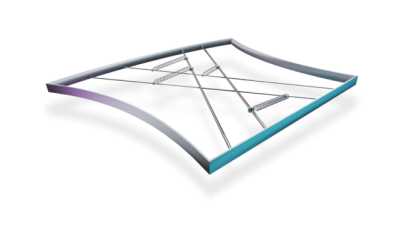

This model has two strings connected to a plate using nonlinear connections that can either be rattles or springs. These strings are retuned on-the-fly to give 6 octaves of monophonic or duophonic sound. The plate can act as a soundboard by varying its decay, mass and fundamental frequency. These, along with the connection controls, can all be changed in real-time.
A driver signal is used to excite the top plate, which is connected to the bottom plate with two nonlinear connections. This driver can be a polyphonic sawtooth or sine wave, or a multi-striking hit for percussive effects. There is also an option to use a single plate connected to ground.

Gadi Sassoon is a world class composer, pioneering synthesist and accomplished performer, whose experimental blend of classical and computer music has garnered wide acclaim from audiences as diverse as the United Nations, Leipzig Opera House and prime time TV.
As Physical Audio’s longest running artistic partner, his vision has done much to influence the design of our instruments for the best part of a decade.
He has been creating records, live performances and soundtracks using our algorithms since they were research level machine code, when the Physical Audio team was known as the Next Generation Sound Synthesis project at the University of Edinburgh. Gadi’s first solo album Multiverse was a direct result of our early research, and together we continue exploring new applications of physical modelling to composition and sound art.
Each of these tracks was created using a single preset in Modus. All of the sound is generated from instances of the preset, with minimal post-processing.
3 configurations of physical models
3 configurations of physical models
LFO modulation
Gain mixer with Pre-amp limiter
High and Low-shelf EQ
VCF with circuit-modelled drive section
Stereo Delay
High quality Reverb
VST3 and AAX for Windows
AU, VST3 and AAX Universal Binaries for macOS
Modus now supports custom tuning using the MTS-ESP format. There is a free mini server or a full graphic editing suite. See this post for further details.

- macOS Monterey to Tahoe.
- Intel or Apple Silicon processor.
- Windows 11
- Intel or AMD processor.
Many thanks to the following for their help in developing Modus:
Gadi Sassoon, Alex Truscott, Francis Preve, sadà\exposadà, Lorenzo Lorenti, Daniel Morin, Francesco Gennari and Giovanni Battagliola.
Lionel Schmitt, Tom Mudd, Riccardo Russo and Carlos Davey
Thanks to Plugin Noise for featuring and supporting our instruments.
Modus uses our latest research in collision modelling to connect acoustic elements together. Strings, plates, springs and rattles collide, literally, in algorithmic air to generate tones that resonate and react just like they would outside the virtual realm. These elements are combined in different ways to create three types of instruments.